
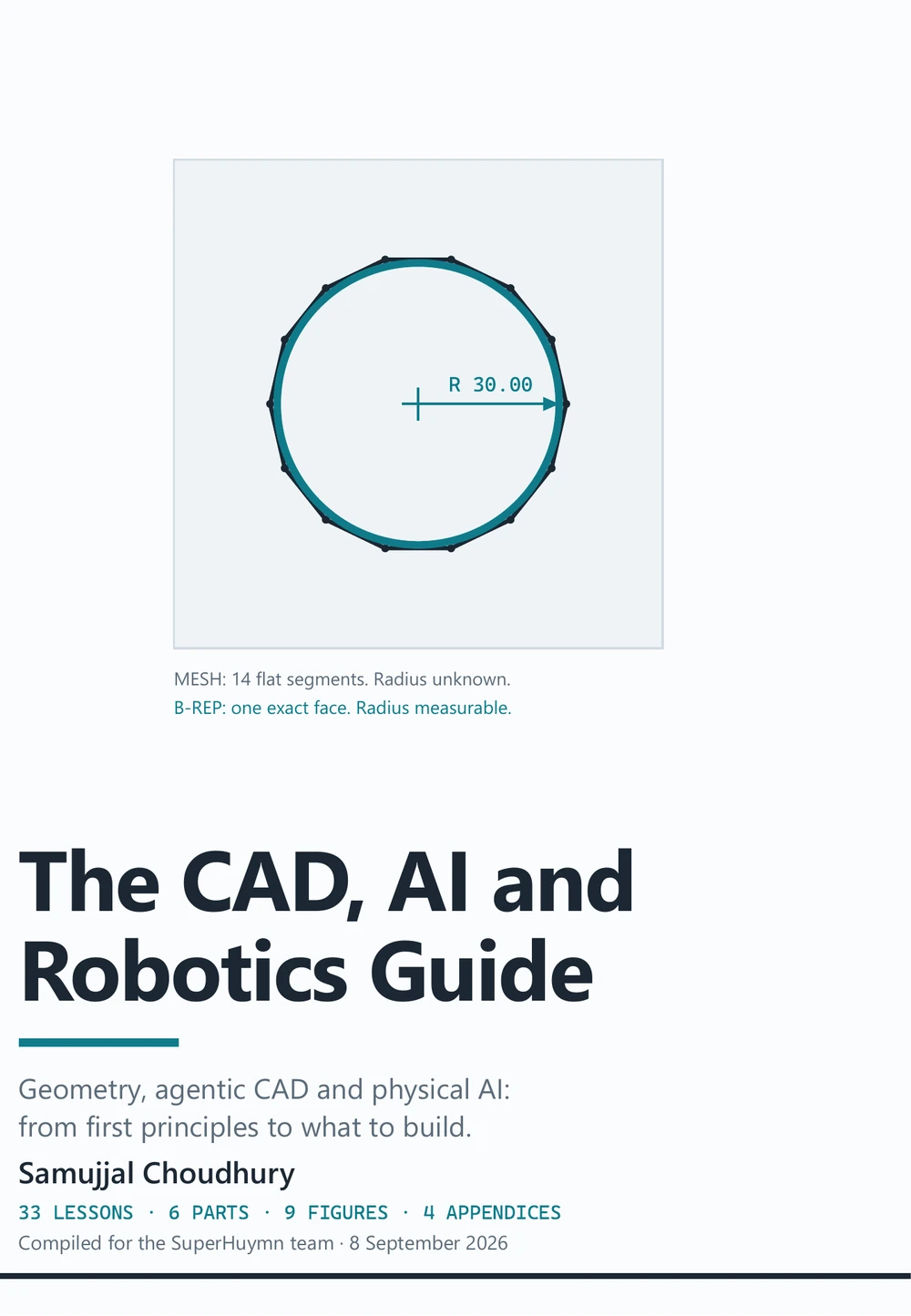
Samujjal Choudhury. Compiled for the SuperHuymn team, 8 September 2026.
The CAD, AI and Robotics Guide
Geometry, agentic CAD and physical AI: from first principles to what to build.
Everyone can generate geometry. Almost nobody can prove it. The field of agentic CAD split into five layers. Four are settled or crowded. One is nearly empty, and it is the one that decides whether a generated part can be trusted, machined and shipped.
Compiled from web research and direct repository inspection, this 112-page guide deconstructs the competitors, the open-source tools, the commercial incumbents, and the precise engineering gaps that separate a visual toy from an industrial tool.
Read the full reportPDF, 112 pages, 33 lessons, 4 appendices
Contents
IFoundations: what geometry is5 lessons06
- 1Why geometry is the whole problem
- 2Two ways to describe a shape
- 3Geometry, topology, and the naming problem
- 4What makes geometry valid
- 5Units, frames and transforms
IIFrom shape to behaviour7 lessons19
- 6Mass properties and the bridge to physics
- 7Collision and clearance
- 8Joints, kinematics and robot descriptions
- 9Constraints and solvers
- 10Tolerances, GD&T and machine-readable intent
- 11Manufacturability as geometry
- 12Meshing for analysis
IIIThe field as it stands11 lessons33
- 13The five layers and where the value sits
- 14Agent harnesses and text-to-CAD
- 15MCP servers and agent skills
- 16Kernels, libraries and the code-CAD stack
- 17Verification and regression, the empty layer
- 18Generative 3D and the one-way wall
- 19Physics engines and simulation
- 20Electronics and firmware
- 21Analysis, optimisation and manufacturing tools
- 22Viewers, frontend and deployment
- 23Backend and agent infrastructure
IVCompetitors and what they teach3 lessons71
- 24How text-to-CAD actually works
- 25The competitors, pulled apart
- 26Twelve lessons, and what to do about each
VEvidence and market4 lessons80
- 27Benchmarks, datasets and proving it works
- 28The commercial field and what the incumbents did
- 29India, funding and go-to-market
- 30The industrial picture
VIDecisions3 lessons93
- 31Where a small team wins
- 32The ranked action list
- 33What could not be verified
Appendices: glossary, failure checklist, robot hardware and demonstration data, sources.